What Canadian Founders Need to Know About Startup Fundraising Consulting
- harryabstain892
- Mar 19
- 6 min read


Raising capital for a startup is one of the most demanding challenges any founder will face. In Canada, the landscape adds its own layer of complexity—a market with strong innovation potential but where early-stage funding gaps are quietly widening. According to recent data from the Canadian Venture Capital and Private Equity Association (CVCA), total VC investment in Canada reached CAD 7.9 billion across 592 deals in 2024. Yet despite that headline figure, seed-stage capital fell nearly 47% year-over-year, and Canadian startups take between 15% and 40% longer to close their first rounds compared to their U.S. counterparts.
That gap is precisely why startup fundraising consulting services have grown in relevance for Canadian founders. These services bridge the distance between a founder with a strong idea and an investor ready to deploy capital—helping startups build the materials, strategy, and connections they need to compete in a market that rewards precision.
What Startup Fundraising Consulting Actually Involves
Many founders assume that fundraising consulting means receiving a list of investors and getting help polishing a slide deck. The reality is considerably more strategic. A capable fundraising consultant works across the entire capital-raising lifecycle:
Round planning and strategy: Determining how much to raise, at what valuation, and from which investor type—whether angel investors, seed VC firms, or institutional growth funds.
Pitch deck development: Crafting the narrative that communicates your problem-solution fit, market opportunity, competitive landscape, and traction to investors who see hundreds of pitches monthly.
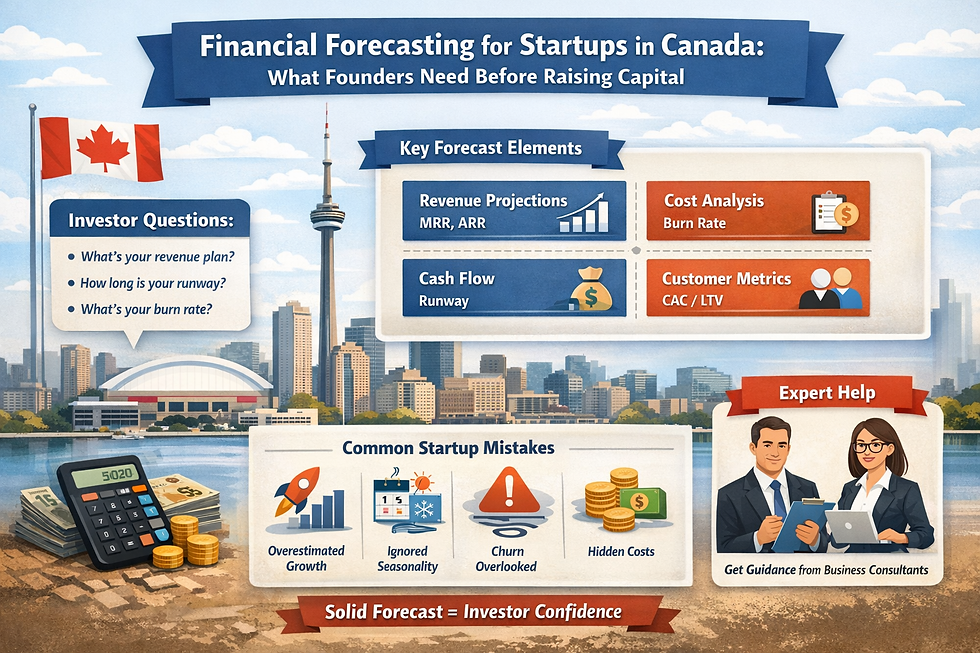
Financial model preparation: Building investor-grade forecasts that demonstrate a credible path to profitability or scale—not just optimistic projections on a spreadsheet.
Investor targeting: Curating a shortlist of investors actively deploying capital in your specific vertical and stage, using data sources such as Pitchbook and CVCA's research.
Outreach and facilitation: Managing introductions, follow-up sequencing, and pre-meeting preparation to maximize the quality of every investor conversation.
Term sheet support: Helping founders understand deal terms, dilution implications, and negotiation leverage before anything is signed.
This type of structured support can compress a process that typically spans nine to twelve months into a disciplined, outcome-focused campaign.
The Canadian Funding Reality Right Now
Understanding the current market is critical before engaging any consulting partner. Canada is home to over 31 unicorns and has produced landmark technology companies including Shopify, Wealthsimple, and Cohere. Toronto accounts for roughly 40% of all VC deals nationally. Montréal has become a globally recognized hub for AI investment, and Vancouver continues to grow in cleantech and biotech.
But for early-stage founders, the picture is more complicated. A 2025 study from the National Angel Capital Organization (NACO) and Startup Genome found that Canada's top startup hubs missed out on an estimated USD 66 billion in value between 2019 and 2024. Seed rounds in Canadian cities are, on average, 40% smaller than comparable raises in U.S. hubs—a disparity that has grown steadily since 2012. Only around 6% of companies founded in 2024 secured any early-stage venture funding at all.
The capital that does exist is consolidating in fewer, later-stage deals. Megadeals worth $50 million or more accounted for roughly two-thirds of all capital raised in Canada in 2025. Series A and B deals fell to just two-thirds of 2024 levels, with deal count dropping 28% year-over-year. The average funding round now sits around CAD 14 million.
This environment means that early-stage founders need to arrive more prepared, more targeted, and more investor-ready than previous generations. A fundraising consultant brings structure to a process that most first-time founders approach without a clear framework.
Why the Pitch Deck Alone Is Not Your Fundraising Strategy
One of the most common misconceptions among Canadian founders is that a great pitch deck is the primary entry ticket to investor meetings. Investors who review hundreds of decks each month have become highly selective. Less than 1% of startups ever secure venture capital. What separates those that succeed is rarely the quality of the design—it is the strength of the underlying investment case.
A credible investor narrative includes deeply researched market sizing, a defensible business model backed by evidence of real traction, financial projections built on verifiable assumptions, and a clear explanation of why this founding team is positioned to win in this specific market right now.
Financial modeling is where the majority of founders are most exposed. Building an investor-grade financial model—one that can survive due diligence, withstand stress-testing, and benchmark credibly against comparables in your sector—requires a combination of financial expertise and market knowledge. Firms like Saz Square, which specialize in CFO advisory, financial modeling, and pitch deck strategy for startups and growth-stage businesses, understand that the numbers and the narrative must work in tandem. Investors are too experienced to treat them separately.
Investor Targeting: The Research Work Most Founders Skip
The majority of the effort in a successful fundraise happens before any investor meeting takes place. Identifying the right investors means understanding who is actively deploying capital in your sector, at your stage, and with check sizes that fit your round structure. It is a research-intensive process that most founders significantly underestimate.
In the Canadian context, that means knowing which VC funds have shifted from seed to growth-equity and are no longer relevant for early-stage deals. It means understanding that American participation in Canadian VC dropped from 32% to 25% of deals between 2024 and 2025, narrowing access to cross-border capital. It means targeting the right geography—AI deals in Montréal sit in a different ecosystem from fintech deals in Toronto's Financial District.
Experienced fundraising consultants handle this systematically. They build targeted outreach campaigns with personalized messaging, manage investor pipelines through CRM platforms, and run follow-up cadences that maintain momentum without burning relationships. The objective is not a mass blast to a generic list—it is engineering high-quality conversations with investors who have a genuine reason to engage.
When a Canadian Startup Should Actually Hire a Consultant
Not every startup needs external fundraising consulting at every stage. The decision typically comes down to three factors: experience, access, and bandwidth.
Experience: Founders raising institutional capital for the first time—without prior exposure to term sheet structures, due diligence processes, or VC dynamics—benefit enormously from guided support. The learning curve without it can cost both time and deal quality.
Access: Founders building companies outside of Toronto, Montréal, or Vancouver face a real geographic access problem. Consultants with established investor relationships can open doors that location and professional network would otherwise keep closed.
Bandwidth: Running a business and a fundraising process simultaneously is the default reality for most founders. Having professionals manage the investor relations process while founders continue building removes a significant operational burden.
The right time to engage a consultant is when the business has something concrete to show: measurable traction, early revenue, a validated product, or clear proof of concept. Startups with no product and no traction are rarely ready for institutional fundraising regardless of how well the process is managed.
Government Programs That Work Alongside Investor Capital
Canada's public funding programs are a meaningful and often underutilized part of the broader capital strategy. The Scientific Research and Experimental Development (SR&ED) tax credit program offers eligible companies up to CAD 3.5 million annually in refundable credits. BDC (Business Development Bank of Canada) participated in 698 funding rounds in 2024 alone, making it one of the most active investors in the country. The Startup Visa Program offers qualifying international founders a pathway to permanent residency while launching a business in Canada.
Layering non-dilutive capital—grants, SR&ED credits, and government co-investment—alongside equity financing is a strategy experienced consultants help founders plan early. A cap table that includes non-dilutive funding extends runway and creates better negotiating leverage with private investors who see a founder who has already validated their business through other sources.
How to Choose the Right Fundraising Consulting Partner
Not all fundraising consultants operate with the same model or incentives. Some charge flat retainers. Others work on a success fee tied to capital raised. Some offer pitch deck design exclusively; others manage the full investor outreach process from discovery through close.
Questions worth asking before signing any engagement include whether the firm has verifiable experience with Canadian startups in your sector, whether they can provide references from founders at comparable stages, what their specific process looks like from strategy through term sheet, and how transparent they are about realistic timelines and expected outcomes.
A well-run fundraising campaign typically spans ten to fourteen weeks for the initial outreach phase, with the full round closing anywhere from three to twelve months after first investor contact. Knowing what to expect at each phase—and having experienced support at every step—is what separates founders who close successfully from those who exhaust runway in the process.
Final Thoughts for Canadian Founders
Canada's startup ecosystem is active, well-resourced in aggregate, and capable of producing world-class companies. However, with $11.5 billion in dry powder sitting with Canadian investors and capital increasingly concentrated in later-stage deals, early-stage founders face a more competitive environment than the headline investment numbers suggest.
Fundraising consulting services exist to close the gap between a founder's vision and an investor's criteria. When done well, they do more than prepare materials. They help founders understand their own investment story more clearly, target capital more precisely, and engage investors from a position of preparation rather than urgency.
In a market where only 6% of new startups secure any venture funding, how well the process is managed often matters as much as how strong the idea is.


Comments