Financial Forecasting for Startups in Canada: What Founders Need Before Raising Capital
- harryabstain892
- Mar 31
- 4 min read

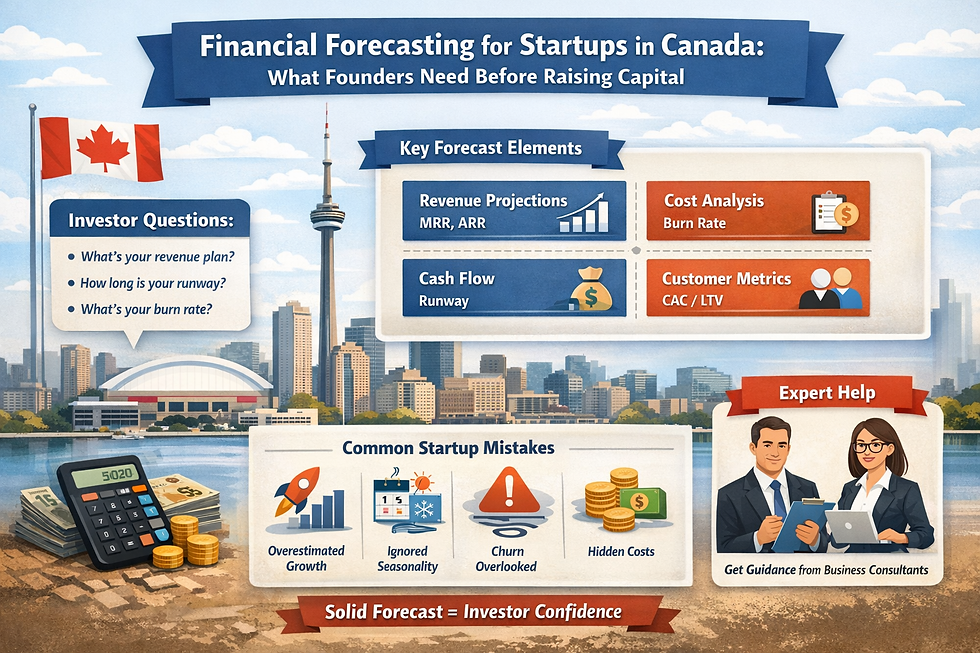
Raising capital in Canada isn’t just about having a strong idea or a polished pitch deck. Founders walk into investor meetings thinking traction or product matters most. It doesn’t—at least not alone.
What actually gets deals moving forward is clarity. Investors want to know one thing: where is this business going financially, and how confident are you about it?
This is where most startups fall apart.
They either:• Guess their numbers• Overestimate revenue• Ignore costs like CAC, churn, or burn rate• Or build unrealistic projections that collapse under basic scrutiny
Financial forecasting is not a formality. It’s the backbone of your fundraising strategy.
What Financial Forecasting Actually Means for Startups
Financial forecasting is not just predicting revenue. It’s building a structured model that explains:
• How your business makes money• How costs behave as you scale• When you become profitable• How long your cash lasts
For Canadian startups, this becomes even more important due to:
• Competitive funding ecosystems (Toronto, Vancouver, Montreal)• Government-backed grants and compliance expectations• Investor focus on sustainable growth vs. hyper-growth
A forecast answers a simple but critical question:
“If I invest today, what happens over the next 12–36 months?”
Why Investors in Canada Care More About Forecasts Than You Think
Investors don’t expect perfection. They expect logic.
A solid financial model shows:• You understand your business mechanics• You can manage capital responsibly• You are aware of risks
In Canada, many investors—especially angel networks and early-stage VCs—prioritize capital efficiency. That means:
• Lower burn rates• Realistic hiring plans• Sustainable growth assumptions
If your numbers feel inflated or disconnected, the conversation ends quickly.
Core Components Every Startup Forecast Must Include
1. Revenue Model Breakdown
You need to clearly define how money comes in.
Examples:• SaaS → Monthly subscriptions (MRR, ARR)• E-commerce → Average order value, repeat purchases• Marketplace → Commission percentages
Avoid vague statements like “we expect rapid growth.” Replace them with:
• Conversion rates• Pricing tiers• Customer acquisition assumptions
2. Cost Structure (Fixed vs Variable)
This is where many founders lose credibility.
Break down:• Fixed costs → Salaries, rent, software tools• Variable costs → Marketing spend, logistics, transaction fees
In Canada, don’t forget:• Payroll taxes• Compliance costs• Regional operational differences
A forecast without cost clarity is useless.
3. Cash Flow Projections
Cash flow matters more than profit in early-stage startups.
You need to show:• Monthly cash inflow vs outflow• Burn rate (how fast you spend money)• Runway (how long you survive without funding)
Example:
If you burn $25,000/month and have $150,000:→ You have 6 months runway
Investors look at this first.
4. Customer Acquisition Metrics
This is where your growth story becomes real.
Include:• CAC (Customer Acquisition Cost)• LTV (Lifetime Value)• Payback period
If CAC > LTV, your model is broken.
Canadian investors especially want to see efficient growth—not just aggressive spending.
5. Hiring and Scaling Plan
Your forecast should reflect team growth.
Include:• When you hire• Why you hire• How each role impacts revenue or operations
Random hiring projections signal poor planning.
Common Forecasting Mistakes Founders Make
Unrealistic Revenue Curves
Straight-line growth rarely happens. Real growth is uneven.
Ignoring Seasonality
Certain industries in Canada fluctuate:• Retail spikes during holidays• Construction slows in winter
Overlooking Churn
Retention matters more than acquisition in many models.
Underestimating Costs
Hidden costs kill startups:• Payment processing fees• Customer support• Infrastructure scaling
How to Build a Forecast That Investors Trust
Start simple. Then layer complexity.
Step-by-step approach:
Define your business model
Estimate customer growth realistically
Assign pricing and revenue per user
Map out costs aligned with growth
Build monthly projections (at least 24–36 months)
Stress-test your assumptions
Ask yourself:• What if growth is slower?• What if CAC increases?• What if funding is delayed?
If your model survives these questions, it’s strong.
Real-World Example (Simplified)
A SaaS startup in Toronto:
• Subscription: $50/month• Expected customers:– Month 1: 50– Month 12: 1,000
Revenue at Month 12:→ 1,000 × $50 = $50,000/month
Now layer costs:• Marketing: $15,000• Salaries: $20,000• Tools & infrastructure: $5,000
Total cost: $40,000
Profit:→ $10,000/month
This is a clean, believable model.
Forecasting Tools Commonly Used by Canadian Startups
• Excel or Google Sheets (most flexible)• Financial modeling templates• Accounting tools like QuickBooks or Xero• Scenario planning tools
But tools don’t matter as much as logic.
A clean spreadsheet beats a complex tool with weak assumptions.
The Role of Professional Guidance
Many founders try to build forecasts themselves. That’s fine in early stages. But when money is on the table, precision matters.
This is where experts step in.
A structured approach from professionals like saz square business consultants helps:
• Validate assumptions• Align forecasts with investor expectations• Prepare financial narratives for pitches• Reduce risk of rejection
The difference is subtle but powerful.
Instead of guessing, you present numbers that hold up under pressure.
What Investors Expect to See in Your Forecast Deck
When you present your financials, keep it clean and focused.
Include:• 3-year projections• Monthly breakdown (Year 1)• Key metrics (CAC, LTV, burn rate)• Break-even point• Funding requirement and usage
Avoid:• Over-designed slides• Overly complex charts• Unsupported assumptions
Clarity wins.
How Financial Forecasting Impacts Valuation
Your forecast directly influences how your startup is valued.
Investors look at:• Revenue potential• Profitability timeline• Risk factors
A strong forecast can justify:• Higher valuation• Better terms• Faster deal closure
A weak one does the opposite.
Final Takeaway
Most founders think fundraising is about storytelling. It’s not.
It’s about proving that your story makes financial sense.
If your numbers are clear, realistic, and backed by logic, investors listen. If not, even the best idea struggles.
Financial forecasting is not optional. It’s your strongest leverage before raising capital.
FAQ Section
What is the ideal length of a financial forecast for a startup?
A standard startup forecast should cover 3 years. Year 1 should be monthly, while Years 2 and 3 can be quarterly or annual projections.
How accurate do financial projections need to be?
They don’t need to be perfect. They need to be logical, consistent, and based on realistic assumptions that can be explained and defended.
When should a startup build its financial forecast?
Before approaching investors. Ideally, you should have a working financial model ready even before building your pitch deck, as it supports your entire fundraising strategy.


Comments