Startup Capital Advisory Services for High-Growth Ventures in Canada
- harryabstain892
- Mar 18
- 6 min read


Access to capital decides how fast a startup moves, how long it survives, and whether it scales or stalls. In Canada, where funding ecosystems are strong but highly competitive, founders often struggle not because of a lack of ideas, but because of poor financial structuring, weak investor positioning, or unclear capital strategy. This is where startup capital advisory services become critical.
These services are not just about raising money. They are about building a funding roadmap, aligning financials with growth goals, and preparing startups to meet investor expectations across different stages.
What Startup Capital Advisory Services Actually Do
Startup capital advisory goes beyond introductions to investors. It is a structured approach to preparing a business for funding and ensuring capital is raised efficiently.
A typical advisory process includes:
• Financial modeling and projections• Valuation strategy and equity structuring• Investor targeting and outreach• Pitch deck refinement• Due diligence preparation• Fundraising strategy across stages
In Canada, startups operate in a well-regulated environment with access to multiple funding channels. However, each funding source has its own expectations, timelines, and documentation requirements. Advisory services bridge this gap.
Why Canadian Startups Need Capital Advisory Early
Canada has one of the most supportive startup ecosystems globally, yet many early-stage companies fail to secure funding due to preparation gaps.
According to Innovation, Science and Economic Development Canada, over 90% of startups face funding challenges in their first three years. This is not always due to lack of demand, but because of weak investor readiness.
Common issues include:
• Overestimated valuations without supporting data• Poorly structured financial forecasts• Lack of clarity on unit economics• Inconsistent pitch narratives• Misalignment between funding stage and business maturity
Advisory services address these issues before founders approach investors, significantly improving success rates.
Types of Funding Available in Canada
Understanding the funding landscape is critical. Canada offers a mix of public and private capital sources.
Government Grants and Programs
Canada is known for its strong government-backed funding ecosystem.
• Industrial Research Assistance Program (IRAP)• Canada Small Business Financing Program (CSBFP)• Scientific Research and Experimental Development (SR&ED) tax incentives
These programs reduce early financial pressure but require detailed compliance and reporting.
Angel Investors
Angel investors play a key role in early-stage funding. Networks like Angel One and National Angel Capital Organization (NACO) support startups across industries.
Typical investment range: CAD 25,000 to CAD 500,000
Advisors help founders align their pitch with what angels prioritize: traction, founder credibility, and market opportunity.
Venture Capital Firms
Canada has a growing VC ecosystem with firms like:
• BDC Capital• Real Ventures• Inovia Capital
Venture capital funding is highly competitive. Less than 1% of startups secure VC investment.
Advisory services focus on:
• Scaling financial projections• Demonstrating product-market fit• Building defensible business models
Private Equity and Growth Capital
For later-stage startups, private equity becomes relevant.
These investors focus on:
• Revenue stability• Profitability or near-profitability• Expansion potential
Advisors help structure deals to protect founder equity while securing growth capital.
Key Components of Effective Capital Advisory
Not all advisory services deliver results. High-performing advisory firms focus on a few critical areas.
Financial Modeling That Investors Trust
Investors in Canada expect realistic, data-backed projections.
A strong model includes:
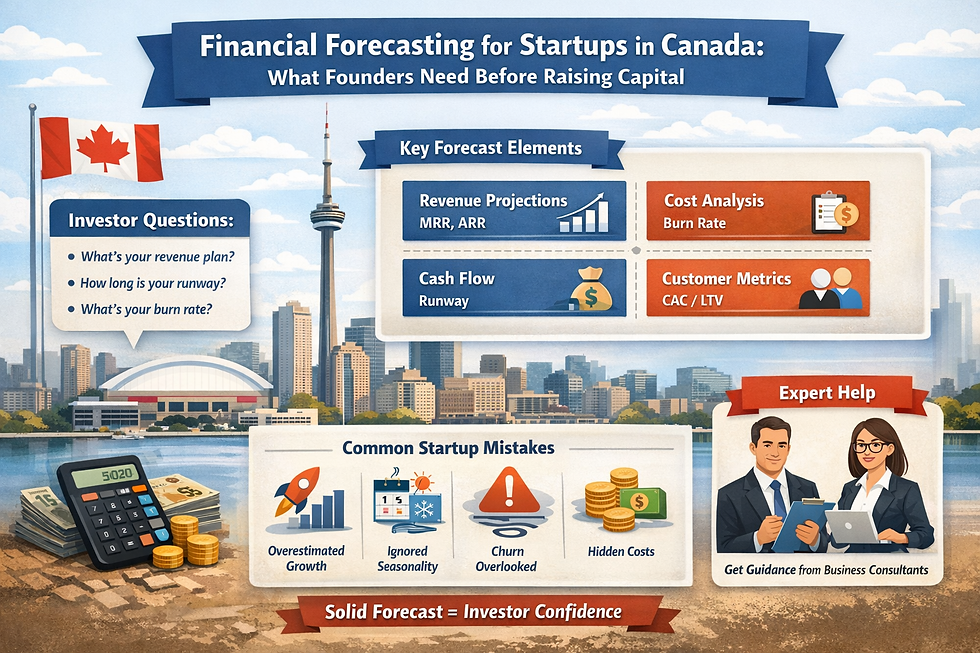
• Revenue streams with assumptions• Cost structure and burn rate• Customer acquisition cost (CAC)• Lifetime value (LTV)• Break-even analysis
Poor financial modeling is one of the top reasons investors reject startups.
Valuation Strategy
Setting the right valuation is critical.
Overvaluation scares investors. Undervaluation dilutes founders unnecessarily.
Advisors use methods like:
• Discounted Cash Flow (DCF)• Comparable company analysis• Precedent transactions
In Canada, pre-seed valuations typically range between CAD 1M to CAD 5M, while Series A can range from CAD 10M to CAD 30M depending on traction.
Investor Positioning
Every investor has a thesis. Sending the same pitch to everyone reduces success chances.
Advisors segment investors based on:
• Industry focus• Investment stage• Ticket size• Geographic preference
This targeted approach improves response rates and reduces time spent on fundraising.
Pitch Deck Optimization
Your pitch deck is your first impression.
Top-performing decks include:
• Clear problem statement• Scalable solution• Market size (TAM, SAM, SOM)• Traction metrics• Business model clarity• Strong financials• Exit strategy
Advisors refine both content and storytelling to match investor expectations.
Due Diligence Preparation
Investors conduct thorough due diligence before closing deals.
Startups must prepare:
• Financial statements• Legal documents• Cap table• Intellectual property details• Customer contracts
Advisory services ensure everything is organized before investor review begins.
The Cost of Poor Capital Strategy
Many startups focus only on raising funds quickly. This often leads to long-term problems.
Common mistakes include:
• Raising too much too early• Giving away excessive equity• Misusing capital without clear allocation• Choosing the wrong investors
These mistakes can limit future funding rounds and reduce founder control.
A structured advisory approach prevents these issues.
How Capital Advisory Impacts Growth
Capital is not just about survival. It is about scaling efficiently.
Startups with strong advisory support typically:
• Raise funds faster• Achieve better valuations• Maintain healthier cap tables• Build long-term investor relationships
A report by the Business Development Bank of Canada (BDC) shows that startups with structured financial planning grow up to 2x faster than those without.
Industry Trends in Startup Funding (Canada)
Understanding current trends helps position startups effectively.
Increased Focus on Profitability
Investors are shifting from growth-at-all-costs to sustainable growth.
Startups must show:
• Clear revenue paths• Controlled burn rate• Strong unit economics
Sector-Specific Funding Growth
Certain sectors attract more capital:
• Clean technology• Artificial intelligence• Health tech• Fintech
Advisors align startups with sector trends to improve funding chances.
Rise of Alternative Funding
Beyond traditional funding, startups now explore:
• Revenue-based financing• Crowdfunding platforms• Venture debt
Each option has different implications on ownership and cash flow.
When Should Startups Hire a Capital Advisor
Timing matters. Many founders seek help too late.
Ideal stages to engage advisory services:
• Pre-seed stage (idea validation and financial setup)• Seed stage (first investor outreach)• Growth stage (scaling capital strategy)
Early engagement leads to better preparation and higher success rates.
What to Look for in a Capital Advisory Firm
Not all advisors deliver value. Founders should evaluate carefully.
Key factors include:
• Experience in the Canadian market• Track record of successful fundraises• Industry expertise• Strong investor network• Transparent fee structure
A reliable advisor works as a strategic partner, not just a service provider.
Metrics Investors in Canada Care About
Understanding investor expectations gives startups an advantage.
Key metrics include:
• Monthly Recurring Revenue (MRR)• Customer Acquisition Cost (CAC)• Lifetime Value (LTV)• Churn rate• Gross margin• Runway
For SaaS startups, a strong LTV:CAC ratio (typically 3:1) is considered healthy.
Common Challenges in Canadian Fundraising
Even with strong ecosystems, startups face barriers.
Geographic Fragmentation
Canada’s startup ecosystem is spread across cities like Toronto, Vancouver, Montreal, and Calgary.
This creates challenges in networking and investor access.
Conservative Investment Culture
Compared to the U.S., Canadian investors are more risk-aware.
Startups must provide stronger validation and traction.
Longer Fundraising Cycles
Fundraising in Canada can take 4 to 9 months depending on stage.
Advisors help shorten this cycle by improving readiness and targeting the right investors.
Building a Long-Term Capital Strategy
Fundraising should not be reactive. It should be planned.
A strong capital strategy includes:
• Clear milestones for each funding round• Defined use of funds• Balanced equity distribution• Exit planning
Startups that plan multiple funding rounds early avoid dilution issues and maintain strategic control.
The Role of Advisory in Scaling Beyond Funding
Capital advisory does not end after raising funds.
Ongoing support includes:
• Financial restructuring• Investor reporting• Growth planning• Preparing for next funding round
This continuous support ensures startups remain aligned with investor expectations.
Real Impact on Startup Success
Startups that engage professional advisory services early gain a measurable advantage.
They are better prepared, more confident in investor conversations, and more strategic in decision-making.
This is especially important in competitive ecosystems like Canada, where investors evaluate hundreds of startups for every deal they close.
In this context, having structured support from firms like saz square can significantly improve investor readiness and long-term growth outcomes.
Final Thoughts
Startup capital advisory services are no longer optional. They are a strategic requirement for founders who want to scale efficiently and compete in mature markets like Canada.
Raising capital is not just about securing funds. It is about building a foundation for sustainable growth, protecting equity, and aligning financial strategy with business vision.
Startups that approach fundraising with preparation, clarity, and expert guidance stand out. They move faster, negotiate better, and build stronger relationships with investors.
In a landscape where capital is available but highly selective, the difference between success and failure often comes down to how well a startup prepares before asking for funding.


Comments