How Venture Capital Funding Works: A Complete Guide for Canadian Startups
- harryabstain892
- Feb 26
- 6 min read


Venture capital funding is one of the most powerful tools available to startups that want to scale quickly. It provides access to large amounts of capital, experienced investors, and strategic guidance that can accelerate growth. In Canada, venture capital plays a critical role in supporting innovation across industries such as technology, healthcare, artificial intelligence, clean energy, and financial services. According to the Canadian Venture Capital and Private Equity Association (CVCA), venture capital investments in Canada reached over CAD $6.9 billion in recent years, reflecting strong investor confidence in emerging companies.
Understanding how venture capital works helps founders prepare for funding, avoid costly mistakes, and improve their chances of securing investment. This guide explains the venture capital process, stages, structure, requirements, and outcomes, specifically for startups operating in Canada.
What Is Venture Capital Funding
Venture capital is a form of private equity financing provided to early-stage and growth-stage companies that have high growth potential. Unlike traditional bank loans, venture capital does not require repayment. Instead, investors receive ownership equity in the company.
Venture capital firms raise money from institutional investors such as pension funds, insurance companies, family offices, corporations, and high-net-worth individuals. These investors are called Limited Partners (LPs), while the venture capital firm managers are called General Partners (GPs). The General Partners invest this pooled capital into startups that show strong growth potential.
The main objective of venture capital investors is to achieve high returns, typically through acquisition or public listing.
How Venture Capital Differs from Other Funding Types
Startups can raise money from multiple sources. Venture capital differs significantly from traditional funding options.
Funding Type | Repayment Required | Equity Given | Risk Level | Typical Amount |
Bank Loans | Yes | No | Low | $10,000 – $500,000 |
Angel Investors | No | Yes | Medium | $25,000 – $500,000 |
Venture Capital | No | Yes | High | $500,000 – $50 million |
Government Grants | No | No | Low | $5,000 – $500,000 |
In Canada, government programs such as SR&ED tax credits and Innovation Canada grants support startups, but venture capital provides significantly larger funding for rapid scaling.
Why Venture Capital Firms Invest in Startups
Venture capital investors look for startups that can deliver large returns. Since many startups fail, investors rely on a few successful companies to generate significant profits.
Investors evaluate startups based on several key factors:
• Market size and growth potential• Strength of the founding team• Product innovation and competitive advantage• Revenue model and scalability• Customer demand and traction• Industry trends and disruption potential
Canada’s startup ecosystem has produced successful companies such as Shopify, Lightspeed, and Wealthsimple, which attracted major venture capital investment and achieved global growth.
Venture Capital Funding Stages Explained
Venture capital funding is provided in stages. Each stage supports specific business growth milestones.
Pre-Seed Stage
This is the earliest stage of funding. It helps founders validate their idea, build prototypes, and conduct market research.
Typical investment range: $50,000 to $500,000
Sources include angel investors, incubators, accelerators, and early venture capital funds.
Seed Stage
Seed funding helps startups build their product, hire initial team members, and launch into the market.
Typical investment range: $500,000 to $2 million
At this stage, investors focus on product development, early traction, and initial customers.
Series A Funding
Series A funding helps startups scale operations, improve their product, and expand their customer base.
Typical investment range: $2 million to $15 million
Investors look for:
• Consistent revenue growth• Proven product-market fit• Strong customer acquisition metrics
Series B and Later Rounds
These funding rounds support expansion into new markets, hiring larger teams, and accelerating growth.
Typical investment range: $10 million to $100 million+
Companies at this stage focus on scaling operations nationally or globally.
Venture Capital Funding Process Step by Step
Understanding the venture capital process helps founders prepare effectively.
Step 1: Preparation
Startups must prepare key documents before approaching investors:
• Pitch deck• Financial projections• Business plan• Market research• Product demonstration
Investors expect clear evidence of growth potential.
Step 2: Pitching Investors
Founders present their business to venture capital firms. The pitch explains:
• Problem being solved• Product or solution• Market opportunity• Revenue model• Growth strategy• Funding requirement
Investors evaluate whether the startup fits their investment strategy.
Step 3: Due Diligence
Due diligence is a detailed review of the startup’s business, finances, and operations.
Investors analyze:
• Financial statements• Legal structure• Intellectual property• Customer data• Revenue performance• Team background
This process ensures the investment is safe and justified.
Step 4: Term Sheet Agreement
If investors decide to proceed, they issue a term sheet outlining investment terms.
Key components include:
• Investment amount• Equity percentage• Company valuation• Voting rights• Investor protections
This agreement forms the basis of the investment.
Step 5: Investment and Funding
After final legal agreements, investors transfer funds to the startup. In exchange, they receive equity ownership.
This capital is used to grow the business.
Understanding Startup Valuation in Venture Capital
Valuation determines how much equity investors receive.
There are two key valuation types:
Pre-Money Valuation
This is the company’s value before receiving investment.
Example: Startup valued at $5 million before investment.
Post-Money Valuation
This is the company’s value after investment.
Example:
Pre-money valuation: $5 millionInvestment: $1 millionPost-money valuation: $6 million
Investor ownership: 16.7%
Higher valuation allows founders to retain more ownership.
How Venture Capital Firms Make Money
Venture capital firms generate profits through successful exits.
The main exit strategies include:
Acquisition
Larger companies acquire startups to gain technology, customers, or market share.
Example: Microsoft acquiring startups to expand its technology ecosystem.
Initial Public Offering (IPO)
The startup becomes publicly traded, allowing investors to sell their shares.
Example: Shopify’s IPO created massive returns for early investors.
Secondary Sale
Investors sell shares to other investors.
This allows early investors to exit while the company continues growing.
Venture Capital in Canada: Market Overview
Canada has a rapidly growing venture capital ecosystem supported by government programs, private investors, and institutional funds.
Key venture capital hubs include:
• Toronto• Vancouver• Montreal• Calgary• Waterloo
Toronto is Canada’s largest startup ecosystem, attracting billions in venture capital investment.
Major Canadian venture capital firms include:
• OMERS Ventures• BDC Capital• Real Ventures• Inovia Capital• Georgian Partners
Government programs such as the Venture Capital Catalyst Initiative (VCCI) help strengthen the venture capital ecosystem.
Advantages of Venture Capital Funding
Venture capital provides several benefits beyond funding.
Access to Large Capital
Startups receive funding to scale quickly without repayment obligations.
Strategic Guidance
Investors provide mentorship, industry connections, and growth expertise.
Credibility and Trust
Venture capital backing improves credibility with customers, partners, and future investors.
Faster Growth
Capital allows startups to hire talent, expand marketing, and improve products quickly.
Disadvantages of Venture Capital Funding
Despite its benefits, venture capital has drawbacks.
Equity Dilution
Founders give up ownership and control.
Investor Expectations
Investors expect rapid growth and strong performance.
Loss of Decision Control
Investors may influence strategic decisions.
Difficult Qualification Process
Only a small percentage of startups receive venture capital funding.
Key Metrics Venture Capital Investors Evaluate
Investors rely on performance metrics to evaluate startups.
Important metrics include:
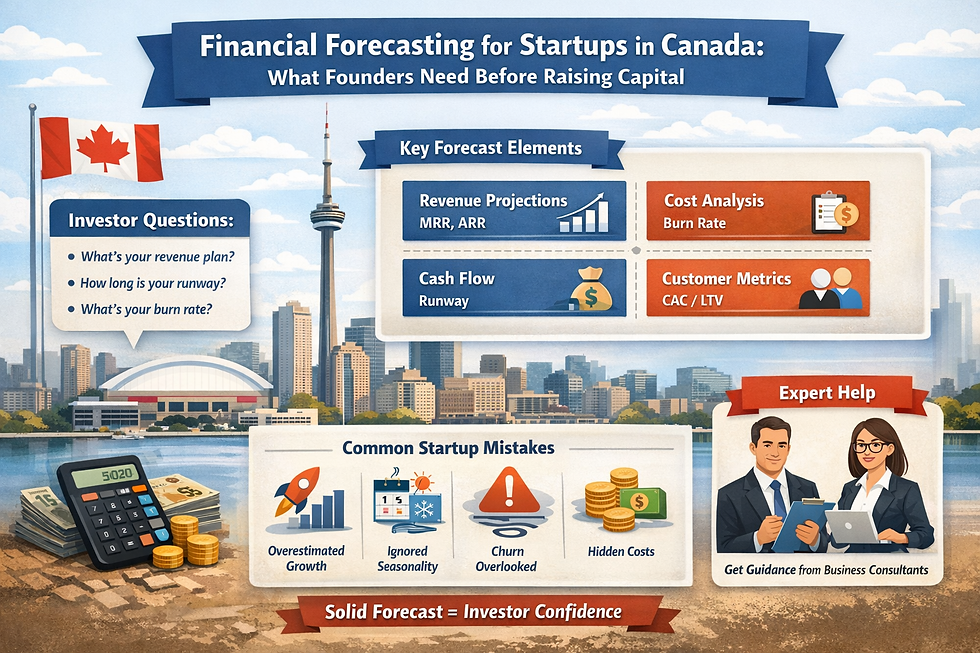
• Monthly recurring revenue (MRR)• Customer acquisition cost (CAC)• Customer lifetime value (LTV)• Revenue growth rate• Burn rate• Market size
Strong metrics increase funding probability.
Common Venture Capital Funding Terms
Understanding venture capital terminology helps founders negotiate better.
Equity
Ownership percentage given to investors.
Dilution
Reduction in ownership due to new investment.
Cap Table
Table showing ownership structure.
Exit
Event where investors sell their shares.
Runway
Time before startup runs out of cash.
How Canadian Startups Can Improve Their Chances of Getting Funded
Investors look for startups that demonstrate clear growth potential and execution capability.
Startups should focus on:
• Building strong product-market fit• Demonstrating customer demand• Showing revenue growth• Hiring experienced team members• Creating scalable business models
Startups that show traction attract more investor interest.
Professional financial planning, valuation modeling, and investor preparation can significantly improve funding success. Many Canadian founders work with advisory firms like saz square to prepare investor-ready business plans and financial projections that align with venture capital expectations.
Venture Capital vs Angel Investors
Although both provide startup funding, they differ in scale and structure.
Feature | Angel Investors | Venture Capital |
Investment Size | Smaller | Larger |
Funding Stage | Early | Growth |
Decision Speed | Faster | Slower |
Investor Structure | Individual | Institutional |
Many startups begin with angel investors before moving to venture capital.
Timeline of Venture Capital Funding
The venture capital funding process takes time.
Typical timeline:
• Preparation: 1–3 months• Pitching investors: 2–6 months• Due diligence: 1–3 months• Legal and funding completion: 1–2 months
Total timeline: 3–12 months
Planning ahead improves success.
Future of Venture Capital in Canada
Canada’s venture capital ecosystem continues to expand due to strong innovation and government support.
Emerging sectors attracting investment include:
• Artificial intelligence• Fintech• Clean technology• Health technology• Software-as-a-Service
Canada ranks among the top countries globally for startup innovation and venture capital growth.
Conclusion
Venture capital funding plays a vital role in helping Canadian startups grow and compete globally. It provides access to large capital, strategic expertise, and industry networks that accelerate business growth. Understanding funding stages, valuation, investor expectations, and the funding process helps founders prepare effectively and improve their chances of securing investment.
While venture capital involves giving up equity and meeting investor expectations, it remains one of the most effective ways for startups to scale rapidly. With proper preparation, strong metrics, and a scalable business model, Canadian startups can attract venture capital and build successful companies.


Comments