Best Gun Safe for Pickup Trucks and SUVs
- harryabstain892
- Feb 5
- 7 min read

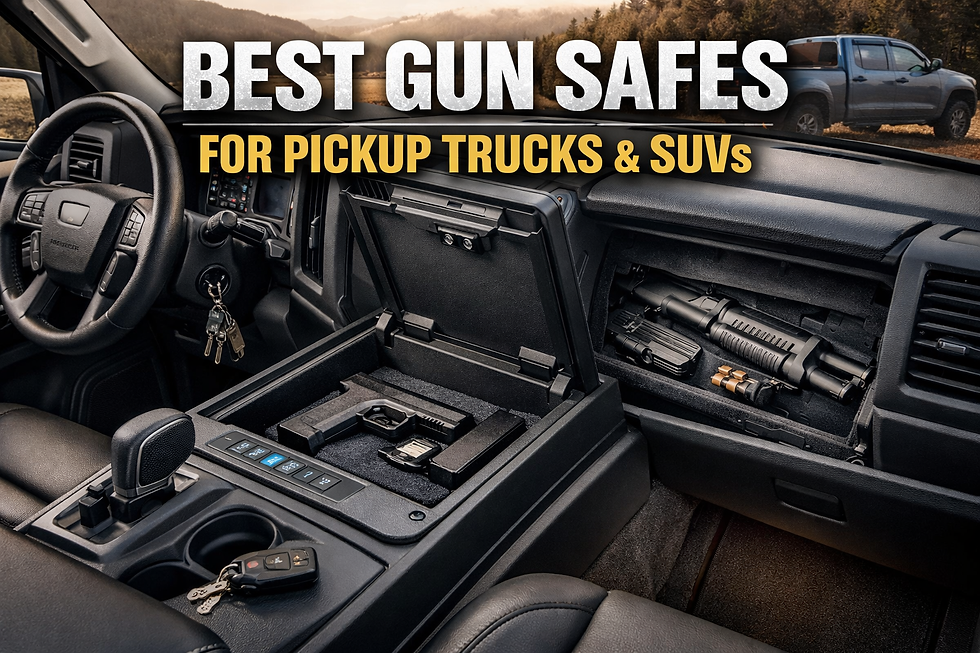
Carrying a firearm in a pickup truck or SUV comes with a very different set of risks than home storage. Vehicles are temporary, highly visible targets. Break-ins are fast. Storage spaces are tight. Temperature swings are extreme. And access needs to be quick ,but never careless.
This guide focuses on real-world vehicle use for U.S. drivers and owners who rely on trucks and SUVs every day. It combines what the highest-ranking industry guides consistently cover ,console safes, under-seat safes, cable lockboxes, and vehicle-specific vaults ,while adding practical field considerations that are usually missing.
If you use a truck or SUV for work, travel, hunting, or personal defense, this article will help you choose a solution that actually fits your vehicle and your lifestyle.
Why vehicle gun storage is different from home storage
A vehicle is not a controlled environment.
Inside a parked pickup or SUV, temperatures can exceed 130°F in many U.S. states during summer months. Cold climates can push interior temperatures well below freezing. Moisture, vibration, and constant movement all affect long-term firearm protection.
More importantly, vehicles are a major theft target.
According to the U.S. Department of Justice and industry reporting cited by major firearm-safety organizations, a large share of stolen firearms in the United States are taken from unattended vehicles. Smash-and-grab thefts typically last under 60 seconds. A soft case or factory console latch provides almost no real resistance.
A vehicle gun safe must therefore solve four problems at once:
• physical security• concealment• vibration and temperature exposure• fast, reliable access in awkward seating positions
Home safes are not built for any of those conditions.
Legal responsibility and vehicle storage expectations in the U.S.
Federal law does not mandate a single nationwide standard for how firearms must be stored inside private vehicles. However, several states and municipalities impose specific requirements related to:
• loaded versus unloaded transport• locking requirements• storage around minors• employer parking lot policies
Even where laws are less explicit, negligent storage that leads to unauthorized access can still create civil liability.
From a practical standpoint, locking your firearm inside a secured container mounted to the vehicle is the safest compliance position across jurisdictions.
The three main types of vehicle gun safes
All high-ranking guides group vehicle storage into three functional categories. Each serves a different type of truck or SUV owner.
1. Vehicle-specific console and floor vaults
These are metal vaults designed for a specific vehicle model and trim.
They install inside the factory center console, jump seat console, or rear floor compartment.
Two of the most recognized manufacturers in this category areConsole Vault andLock'er Down.
Key advantages:
• hidden behind factory panels• bolted directly to the vehicle structure• extremely resistant to pry attacks• preserve a factory appearance
Limitations:
• higher cost• permanent installation• not transferable between vehicles
For owners who keep the same pickup or SUV long-term, this is the most secure in-vehicle option currently available.
2. Under-seat and rear-seat safes
These safes mount beneath the front seats or behind rear seating areas.
They are typically universal designs with mounting brackets or bolt plates.
Common advantages:
• larger interior capacity• fits compact rifles or large pistols• good access when seated
Limitations:
• requires drilling or bracket installation• visibility when doors are open• limited fitment on trucks with low seat clearance
This style works well for full-size pickups and large SUVs where under-seat height is generous.
3. Portable and cable-anchored lock boxes
These compact safes attach to seat rails or cargo anchors using steel security cables.
Brands such asVAULTEK andHornady dominate this segment.
Advantages:
• low cost• easy installation• transferable between vehicles• suitable for rental vehicles
Limitations:
• lower physical resistance than bolted vaults• cable is the weakest security point
This category is popular with travelers, fleet drivers, and owners who rotate vehicles.
What actually matters when choosing a truck or SUV gun safe
Most comparison articles list features. Very few explain which features actually affect real-world performance inside a vehicle.
Here are the factors that matter.
Mounting strength
The safe itself is only as strong as what it is attached to.
A thick steel enclosure that is connected by a thin cable to a seat bracket is still a cable-secured system.
For high-risk environments, bolted mounting to vehicle structure provides dramatically higher resistance to forced removal.
Access ergonomics from the driver seat
In a truck or SUV, access is usually from a seated position.
Poor designs require:
• twisting the torso• leaning across the cabin• reaching below knee level
In stressful situations, poor access angles cause fumbling.
Console-mounted safes consistently score best for reachability. Under-seat safes vary widely depending on seat position and body size.
Lock reliability under vibration
Electronic keypads and biometric sensors behave differently when exposed to continuous vibration and heat.
Industry testing consistently shows that:
• capacitive fingerprint sensors degrade faster in dusty vehicles• low-cost keypad membranes lose responsiveness in extreme heat
If you choose biometric access, look for models with dual unlocking methods and internal memory redundancy.
Interior padding and firearm retention
Vehicles vibrate constantly.
Loose pistols inside rigid steel enclosures develop finish wear and optic alignment issues over time.
Quality vehicle safes use:
• layered foam• adjustable retention blocks• optic-clearance cutouts
This prevents zero shift for mounted red dots and reduces mechanical wear.
Corrosion protection
Moisture inside vehicles is common—especially in humid states and winter climates.
Powder-coated steel interiors, sealed seams, and desiccant compatibility significantly reduce rust risk.
Center console safes: why they dominate real-world use
Across the highest-ranking vehicle storage guides, console safes consistently receive the highest user satisfaction scores.
There are three reasons.
First, concealment.
The safe is invisible when the console lid is closed.
Second, anchoring.
Console vaults bolt directly to the factory console sub-structure.
Third, access.
The driver can reach the safe without shifting posture.
For full-size pickups such as the Ford F-Series, Chevrolet Silverado, GMC Sierra, RAM 1500, and Toyota Tundra, console vaults offer some of the best fitment options currently available.
Vehicle-specific manufacturers design their vaults around factory wiring clearances, airbag modules, and trim tolerances.
This reduces installation risk and avoids interfering with factory electronics.
Under-seat safes: when they make sense
Under-seat safes are best suited for:
• extended road trips• multiple firearm transport• larger framed handguns• compact carbines
They are especially useful in crew-cab pickups and large SUVs where rear passenger seating is rarely used.
However, under-seat safes must be selected carefully.
Low-profile brackets and seat-track compatibility are critical.
Some vehicles have:
• floor-mounted battery trays• HVAC ducts• hybrid system components
Improper mounting can damage vehicle systems.
Portable lock boxes: realistic expectations
Portable cable-anchored safes serve an important role.
They are ideal for:
• temporary stops• rental vehicles• shared family vehicles• airline travel transitions
However, buyers should understand the tradeoff.
The cable can be cut with hand tools in seconds.
Their purpose is deterrence and legal compliance—not high-security theft resistance.
For travelers who frequently stay in hotels and change vehicles, this is often the only practical solution.
This is also the segment most often referenced by owners who first discover Gunners review while researching travel-friendly storage options.
Common locking systems and how they perform in vehicles
Mechanical key locks
Very reliable under heat and cold.
However, key management inside a vehicle is often overlooked. Lost keys inside glove compartments defeat the entire purpose of the safe.
Digital keypad locks
Offer consistent performance and better durability than most biometric systems in high-temperature environments.
Backlit buttons and raised tactile keys significantly improve low-light access.
Biometric locks
Fast when clean.
Less reliable when exposed to:
• dust• sunscreen residue• sweat• humidity
High-quality models usually combine fingerprint, keypad, and mechanical backup.
Real-world theft resistance
A realistic evaluation of vehicle gun safes must consider three attack types:
• pry attack• smash-and-grab removal• cable cutting
Console and floor-mounted vaults perform best against all three.
Under-seat bolted safes perform well against pry attacks but may still be removable with enough leverage.
Cable-anchored boxes primarily prevent casual theft and unauthorized access.
Capacity considerations for trucks and SUVs
Do not underestimate how quickly interior space becomes limiting.
Optics, extended magazines, and weapon-mounted lights add significant bulk.
Before choosing a model, confirm:
• maximum firearm length• optic height clearance• magazine placement options
Safes that force angled storage can place stress on mounted optics during vibration.
Temperature exposure and electronics
High-ranking product tests consistently note that vehicles expose safes to harsher thermal cycles than indoor environments.
Quality electronic locks are typically rated for:
• 14°F to 122°F operating range
In many southern states, interior vehicle temperatures exceed this range.
If you park outdoors regularly, prioritize:
• mechanical backup access• external emergency power ports
Installation mistakes to avoid
The most common errors seen in real installations include:
• drilling into wiring channels• blocking seat travel• compressing carpet padding under mounting plates• overtightening brackets and warping safe housings
Vehicle-specific vaults minimize these risks.
Universal safes require careful measurement and test fitting.
Storage discipline inside vehicles
Even the best safe fails if used incorrectly.
Good vehicle storage habits include:
• locking the safe every time, even for short stops• removing the firearm when parking overnight at home• using desiccant packs inside the safe• avoiding obvious safe-related decals or branding
Concealment reduces targeting.
Are truck gun racks still relevant?
Overhead and rear-window gun racks remain popular in rural and ranching communities.
However, they offer:
• no theft protection• no child-access protection• high legal risk in many jurisdictions
Modern vehicle storage strongly favors enclosed safes.
Who should choose which type
Console vaults are best for:
• daily drivers• commuters• urban and suburban environments• high theft-risk areas
Under-seat safes are best for:
• road trips• hunting transport• multiple firearm carry
Portable lock boxes are best for:
• rentals• fleet vehicles• temporary travel storage
Final buying guidance
The best gun safe for pickup trucks and SUVs is not defined by brand popularity or marketing claims.
It is defined by:
• how securely it mounts to your vehicle• how naturally you can access it from your seat• how well it tolerates vibration and temperature swings• how effectively it stays hidden
For owners who intend to keep their truck or SUV for several years, a vehicle-specific console or floor vault provides the strongest long-term protection.
For travelers and rotating vehicle users, a high-quality portable safe remains a practical and responsible solution.
Ultimately, proper in-vehicle storage protects not only your firearm—but also your legal standing, your passengers, and your peace of mind.



Comments